
Learning at the point-of-care: AO Trauma provides in-hospital ORP training

Workplace-based education formats such as AO In-Hospital ORP can help hospitals maintain high standards of perioperative care despite increasing staff shortages and other workforce-related challenges. That is the message AO Trauma’s Aldijana Beganović delivered to participants of the 2026 EORNA (European Perioperative Nurses Association) Congress in Dubrovnik, Croatia in May. Beganović highlighted Slovenia as a case study that shows the value of the program.
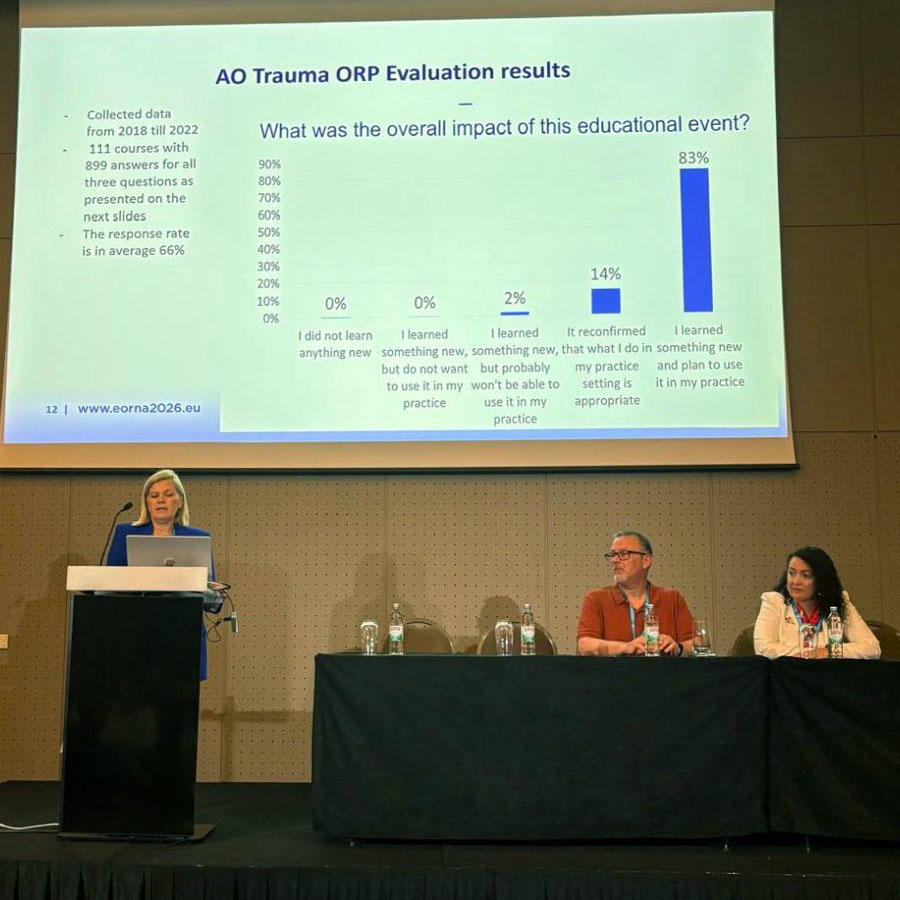
Well-trained operating room personnel (ORP) who regularly take part in education such as the AO Trauma courses for ORP throughout their careers play a key role in providing state-of-the-art medical care to patients. However, hospitals around the world have been contending with a growing lack of qualified ORP in recent years, making it increasingly difficult for many institutions to maintain high standards of perioperative care.
“Hospitals are treating more and more patients, which means that the demands on perioperative nurses are becoming more diverse,” explains Aldijana Beganović, a registered nurse at the University Medical Centre Ljubljana in Slovenia. “But because of the shortages of qualified ORP, many institutions cannot just send their staff away for education for several days to take part in off-site training events.”
Learning where care is delivered
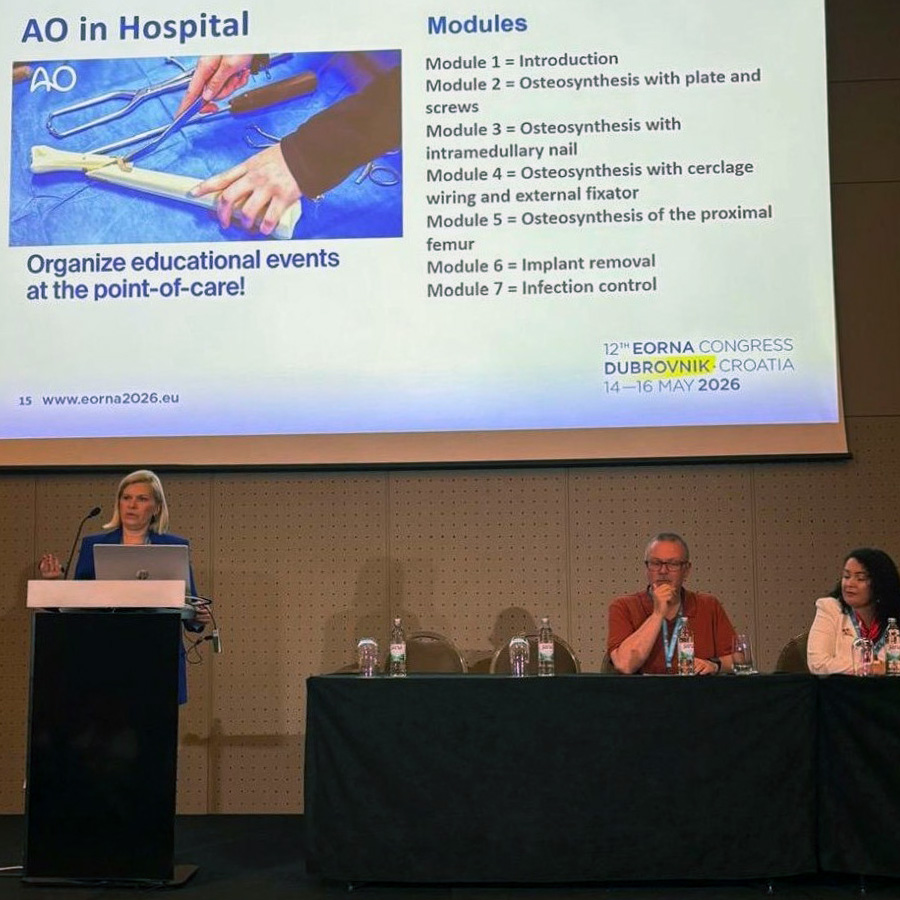
In order to maintain critical education and training despite these challenges, AO Trauma introduced AO In-Hospital for ORP in 2015. The program consists of compact learning modules that cover the basic principles of orthopedic trauma. They are delivered by experienced AO faculty to small groups of nurses, technicians, and ORP in their places of work. The basic idea behind AO In-Hospital for ORP is to decentralize learning in order to make it more accessible, says Aldijana Beganović: “If we know that ORP need continuous education, but hospitals are unable to release them because of staffing shortages, then we must bring the education to them.”
Slovenia shows how the approach can work
A prime example of how hospitals can combine traditional AO Trauma courses with workplace-based education is Beganović’s native Slovenia, where AO Trauma has been organizing courses since 1985. Out of the over 500 educational events that have taken place globally under AO In-Hospital for ORP over the past ten years, 34 were organized in the Central European country.
Over the years, the courses in Slovenia have evolved to better match educational offerings to the experience level of participants: basic courses target early-career ORP within the first five years of their careers, while more experienced professionals can enroll in advanced courses.
There is also strong support from the healthcare institutions themselves. Three major hospitals—the University Medical Centre Ljubljana, the General Hospital Novo Mesto, and the General Hospital Nova Gorica—have put programs in place to formally support the approach. In some cases, says Aldijana Beganović, surgery schedules are adjusted to allow more nurses to attend the sessions: “The surgeons want educated ORP. They support it, because they know how important it is for patient care.”
Combining traditional courses and workplace-based learning
While hospital-based learning makes access to education for ORP easier, traditional courses continue to facilitate more in-depth training with a noted emphasis on hands-on practical sessions. They also provide valuable opportunities for networking, discussion, and learning from colleagues from other institutions.
“AO Trauma courses provide comprehensive knowledge and skills training,” explains Aldijana Beganović. The workplace-based sessions, she adds, help teams apply that knowledge together in their own clinical environment. They also support a culture of continuous learning within hospitals and foster collaboration across surgical teams: “Participants who work together and know each other have more confidence to openly discuss with each other and share their experiences.”
Explore AO In-Hospital for ORP